


Close Menu
Retrofit HomeRetrofit Home
    • Features
    • Industry News
    • Manufacturer News
    • Products
    • Online Exclusives
    What's Hot

    IIDA NY Speaker Will Explore Adaptive Reuse in New York City

    Electric Fireplace’s Lifelike Flames Flicker and Crackle

    Allegion Releases Fire Door Inspections Guide as Part of Building Safety Month

    Facebook X (Twitter) Instagram Pinterest YouTube
    • About
    • Contact Us
    • Media Kit
    Subscribe
    X (Twitter) Facebook LinkedIn YouTube Instagram
    Retrofit HomeRetrofit Home
    • Features
      • Bath
      • DesignVibes
      • Exterior
      • Kitchen
      • Multifamily
      • Outdoor Living
      • Projects
      • RoomReveal
      • Single Family
      • Unique
      • Viewpoint
    • News
      • Industry
      • Manufacturer
    • Online Exclusives
      • Blog
    • Archives
      • Summer 2026
      • Winter 2026
      • Fall 2025
      • Summer 2025
      • Winter 2025
      • Fall 2024
      • Summer 2024
      • Winter 2024
      • Fall 2023
      • Summer 2023
      • Spring 2023
      • Winter 2023
      • Fall 2022
      • Summer 2022
      • Spring 2022
      • Fall 2021
    • Products
      • Appliances
      • Electrical
      • Equipment
      • Fixtures
      • Flooring
      • Glass
      • HVAC
      • Insulation
      • Interior Design
      • Lighting
      • Outdoor Amenities
      • Paints/Coatings
      • Plumbing
      • Roofing
      • Safety
      • Siding & Accessories
      • Solar
      • Structural
      • Surfaces
      • Technology
      • Walls & Ceilings
      • Windows/Doors
    • Metamorphosis Awards
      • 2025 Awards
      • 2024 Awards
      • 2023 Awards
      • 2022 Awards
      • 2021 Awards
      • 2020 Awards
      • 2019 Awards
    Retrofit HomeRetrofit Home
    You are at:Retrofit Home » Features » Single Family » A More than 100-year-old House Embraces City Views from a Modernized Rear Elevation
    Single Family

    A More than 100-year-old House Embraces City Views from a Modernized Rear Elevation

    By Meredith MortonJuly 5, 2022Updated:December 18, 20238 Mins Read
    Share
    Facebook Twitter LinkedIn Email Copy Link

    Austin, Texas, realtor Sylvia Sharplin and entrepreneur Dan Sharplin purchased their new home in the historic and highly desirable Clarksville neighborhood, which flanks the west side of Austin’s downtown. The more than 100-year-old house was among the few remaining that had not been scooped up and demolished, thanks to its previous owner who had lived in the house for more than half a century.

    At the street, the more-than-100-year-old home presents itself as a good neighbor in form, scale and material, all updated to stay true to the original style.

    The couple was drawn to the home because of its one-of-a kind views of the Texas State Capitol and the expanding Austin skyline. Perched on a hill, the house is uniquely located at the threshold between sparkling new downtown high-rises and the historic fabric of one of Austin’s oldest and most storied neighborhoods.

    The home’s north (front) and part of its western street-frontage elevation are part of Austin’s historic overlay and thus subject to close scrutiny by the city. Old Sanborn maps of Austin suggest the house was built in 1915, when its Clarksville neighborhood was considered to be far outside the city, despite it being only eight blocks from the Texas capitol building.

    Austin architecture firm LaRue Architects spent a great deal of time researching the home’s history and consulted with Architexas, a historic-restoration expert, to help inform its work. Along with Four- square Builders, the team took great time and care to hold onto the home’s historic character by maintaining the originally intended front and west façades. The team set out to painstakingly recreate the original house, seamlessly blending old and new into a 3,900-square-foot home (from the original 3,250 square feet).

    OLD AND NEW

    By maintaining the home’s hip roof and wrap-around porch, the front façade remains appropriately in step with the style of the historic neighborhood. “At the street, the home presents itself as a good neighbor in form, scale and material, all updated to stay true to the original style,” says James LaRue, AIA, principal of LaRue Architects. “Even inside the front door, the immediate impression is one of a renovated traditional home, seen in the rich shiplap paneling lining the entry hall.”

    The team had historic photos to guide its design of the front and western façades. In addition, Architexas provided as-built plans, and architects James LaRue and Associate Architect Emily Haydon spent many hours measuring and documenting the building themselves. Surprisingly, when the Sharplins purchased the home, much of the house was in its original state (or resembled its original state).
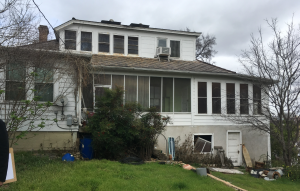
    BEFORE: Surprisingly, when the Sharplins purchased the home, much of the house was in its original state (or resembled its original state). The rear of the home is shown here. PHOTO: LaRue Architects

    A simple material palette was used on the exterior: Poly-ash siding with a wood appearance mimics the original, traditional exterior in the front. Reconstructed traditional windows reside with the original sidelites, which frame a new entry door. Meanwhile, expansive glass, stucco and metal panels were installed on the side that faces downtown and rear of the home to create a modern exterior. Teak decking is used on the porch in front and terrace in the rear as a unifying element. The front façade is a painted soft white shiplap while the back of the house and modern addition is the same color in a contemporary stucco. The team found sconces that not only suit the historic front, but also go well with the very clean back.

    The current dormer is rebuilt to the original dormer design and, because of the historic overlay requirements, it had to remain. In the original plan, this space was occupiable; however, in the current design, it is attic space and houses a mechanical unit.

    The home’s location on a steep hillside presented a number of challenges for the intended work. The pier-and-beam house sat 9 feet off the ground at the site’s lowest point, and the clay content of the soil—though suitable for pier and beam—added structural challenges for the renovation and addition, which included plans for a negative edge pool and floor-to-ceiling windows.

    The pool is essentially cradled from the main house foundation. The water at the negative edge drops a large distance, so the catch basin was brought up to receive the water as it overflows (so the water does not dissipate). This elevation, along with the newly installed floor-to-ceiling windows, is seen clearly from downtown.

    PHOTOS: Casey Dunn Photography

    Author

    • Meredith Morton

      Meredith Morton writes about architecture and design from her home office in Chicago.

      View all posts
    1 2
    historic district historic front elevation Larue Architects modern rear Print
    Share. Facebook Twitter LinkedIn Copy Link
    Previous ArticleA Mid-century Home Feels Inviting Despite Its Rugged Surroundings
    Next Article While Updating an 1845 Farmhouse for Contemporary Living, Artifacts Are Unearthed and Incorporated into the Design

    Related Posts

    After Living in Their Home Many Years, Architects Finally Remodel It to Meet the Needs of Their Family

    September 9, 2025

    A 1920s Tudor Revival Home’s First-floor Renovation Creates Casual, Free-flowing Circulation

    September 9, 2025

    A Third-story Addition Results in a Young Family’s San Francisco Dream Home

    September 9, 2025
    Leave A Reply Cancel Reply

    Stay In Touch
    • Facebook
    • Twitter
    • YouTube
    • LinkedIn
    • Instagram
    Top Posts

    Outdoor Flooring System Snaps Together to Create Foundation for Ground-level Deck

    April 24, 2024767

    Wood-look Siding Is Made of Vinyl

    March 4, 2024373

    The Importance of Custom Door Craftsmanship

    April 23, 2025332

    A Late 1800s Chicago Public School Is Transformed into 23 Apartments Featuring Classic Classroom Details

    November 6, 2023268
    About Us
    About Us

    retrofit home magazine’s goal is to provide designers, contractors and others education about and insight into retrofitting existing homes for the betterment of their owners and communities. Learn More >>

    Facebook X (Twitter) Instagram YouTube LinkedIn
    RetrofitTV

    Experience a world of retrofitting without leaving your desk via our retrofitTV channel. View our current featured video:

    Visit retrofitTV.com to watch more videos from our industry.

    Visit Our Other Publications
    retrofit mag logo
    retrofit tv logo
    © 2026 retrofit home
    • About
    • Contact Us
    • Media Kit
    • Subscribe
    • Privacy Policy

    Type above and press Enter to search. Press Esc to cancel.