



1st Place, Addition
Cities derive their identity and sense of place largely from their architecture. This is particularly true of historic cities, such as Boston. Attention is typically focused on landmark buildings associated with historic events or those best examples of the ornamented past. Often forgotten or thought of as expendable are the workaday industrial or office buildings or indigenous residential building forms that collectively create the fabric that gives historic cities their character and distinguish one neighborhood from the next.
The existing structure at 100 Shawmut, a 6-story Craftsman-style daylit garment factory and warehouse built circa 1915, was just such a building. The site is located in the northwest corner of a section of Boston now known as the Ink Block, a collection of contemporary high-rise office and residential towers, which transformed a formerly industrial area. The new neighborhood is vibrant and attractive but interchangeable in character with any contemporary urban neighbor- hood in any number of American cities.
This is why The Architectural Team Inc., the designers for the redevelopment of the 100 Shawmut site, resisted some voices in the architectural community that suggested yet another tear-down. The existing building was, the designers believed, a familiar local icon, an important punctuation of the easterly termination of the Ink Block and a gateway marker to the low-rise residential neighborhoods of the historic South End.
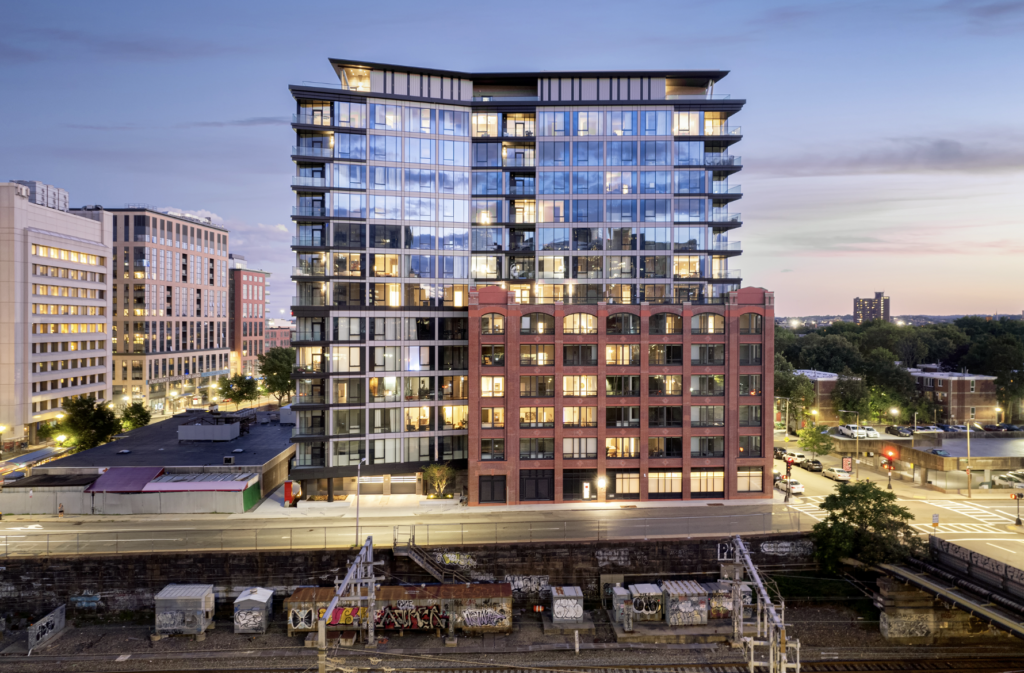
The original warehouse structure hugs the street, as the pinched bowtie shape of the top of the building provides visual relief without sacrificing floor space. 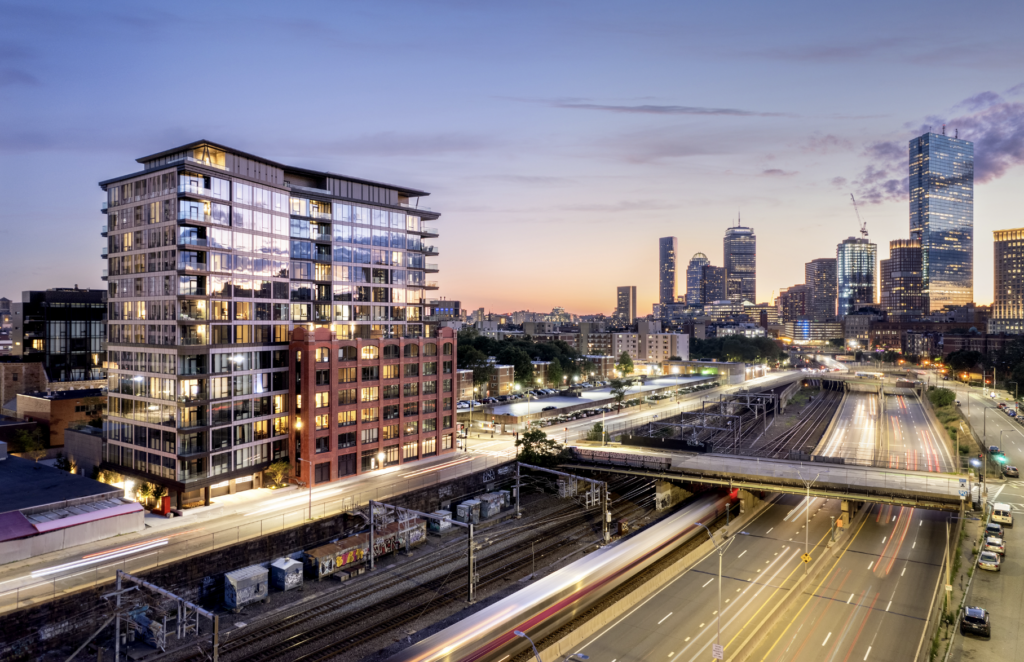
The more than century-old structure is beautifully transformed into 100 Shawmut – a respectful top-to-bottom redesign, yielding an entirely reimagined building with a vertical expansion flooding the space with natural light, an interior environment perfectly suited for today’s urban residents. 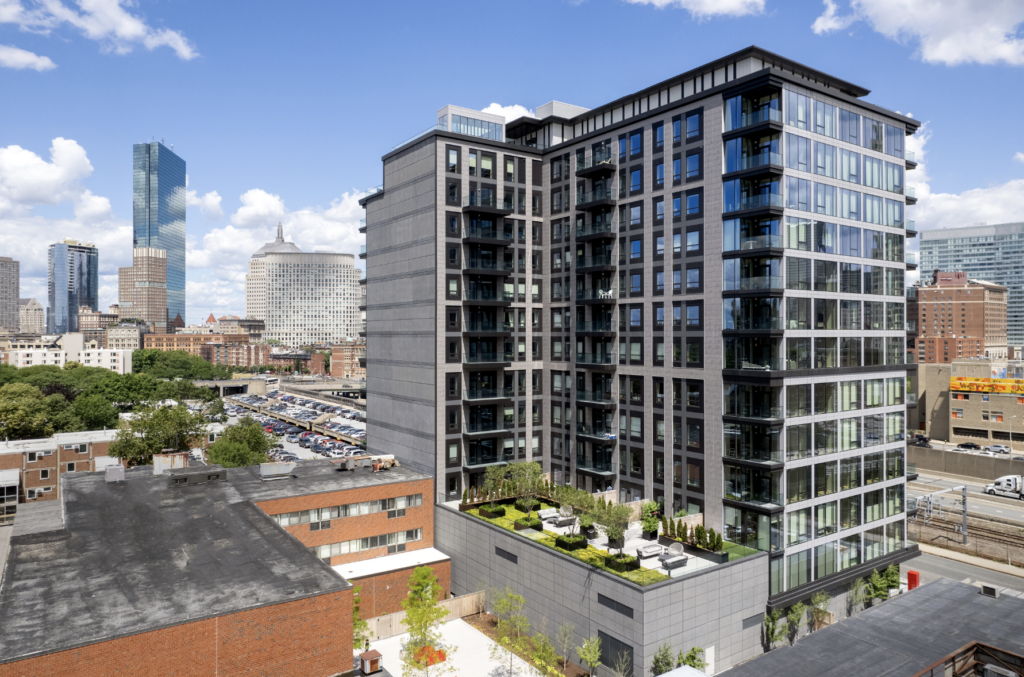
The posterior façades of the addition employ terracotta panels that serve as a warmer face toward the newly created interior courtyard and pocket park, a public space that will be shared by all three buildings in the master plan and benefit the broader neighborhood. 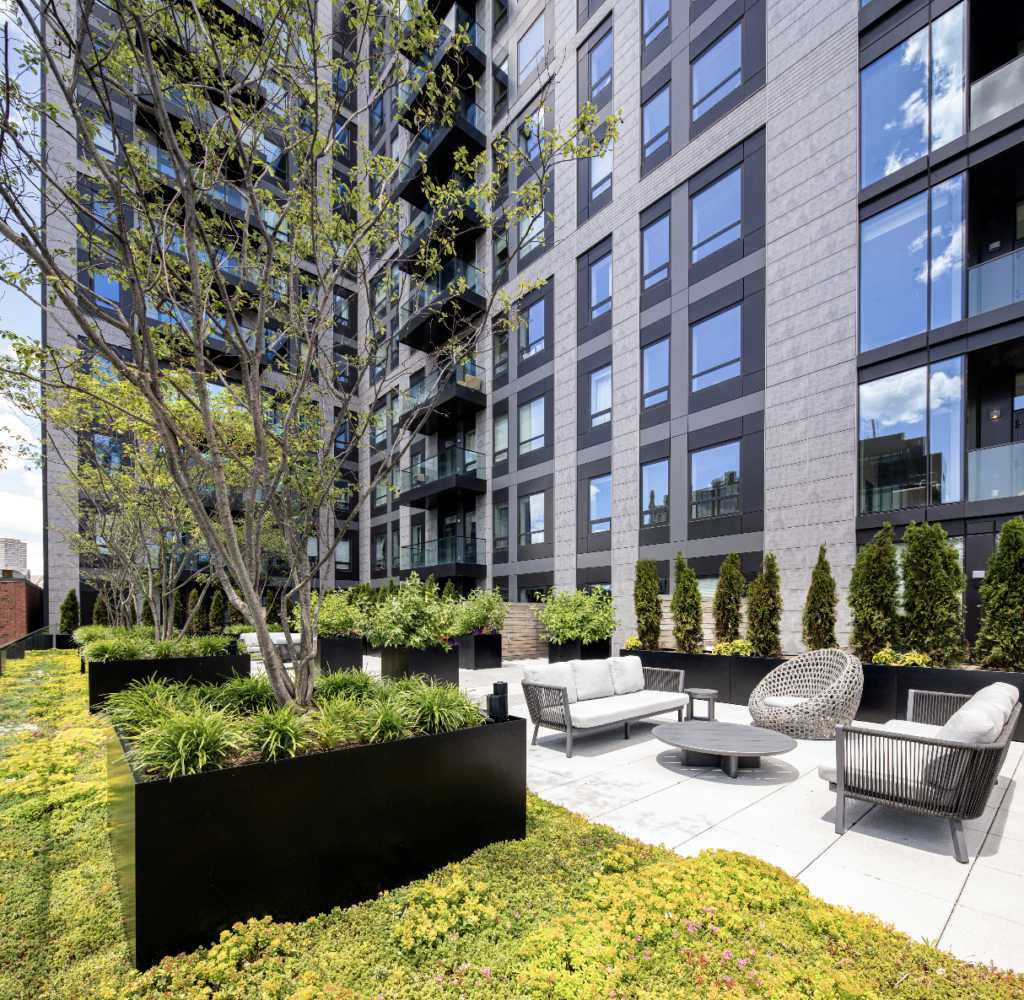
The landscaped terrace on the posterior of the building provides an oasis of green space amid a dense urban environment for the residents of 100 Shawmut. 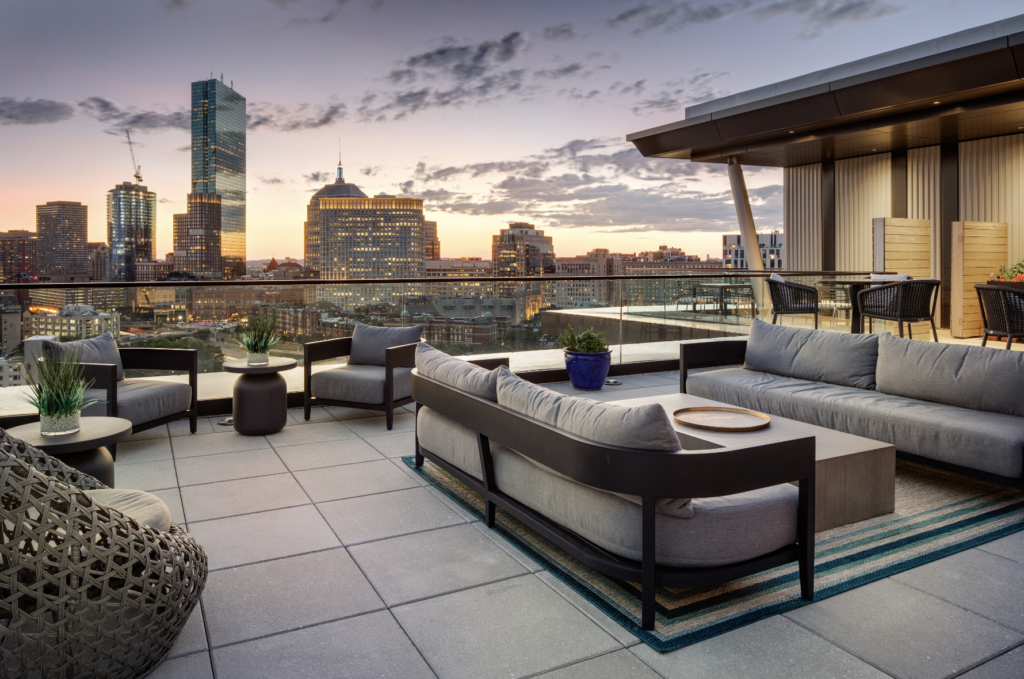
Designed to seamlessly integrate with the interior penthouse clubroom, the rooftop patio conveniently brings the outdoors in and offers residents extended space for entertaining, along with a grilling area, a dog walking space, and epic views. Once a warehouse, now an oasis. 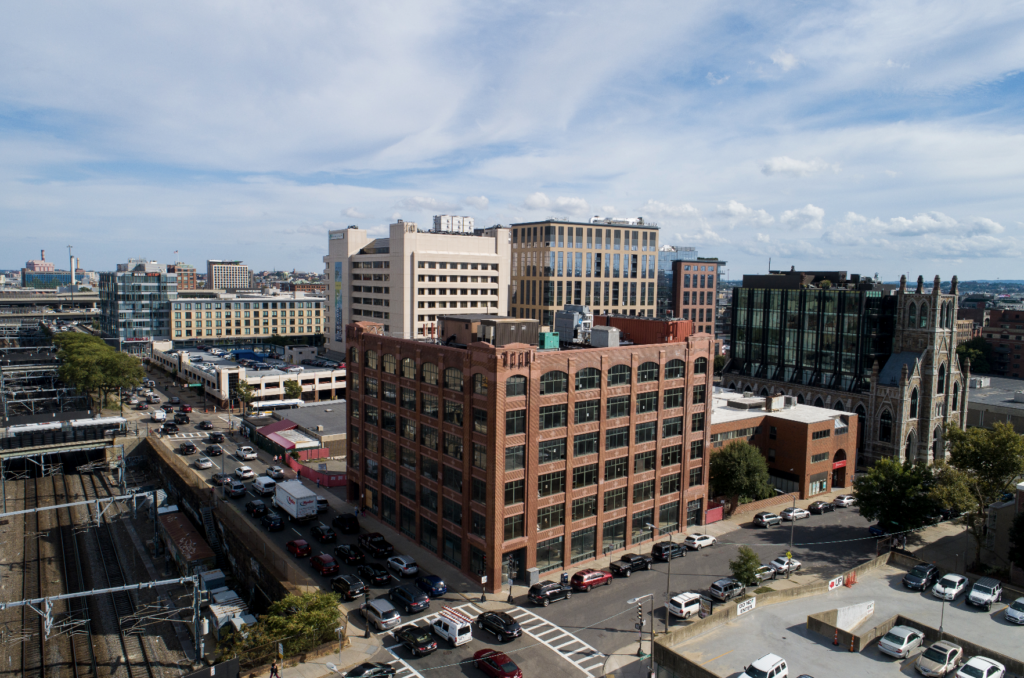
Located on the prominent corner of Herald Street and Shawmut Avenue, the historic concrete and steel-framed warehouse was originally constructed in 1915. The team recognized the importance of promoting the adaptive reuse of the historic structure to ensure robust architectural diversity within the urban landscape. With the creation of an inventive addition, both modern and respectful, the building is preserved and prepared to meet the evolving demands of the 21st Century. PHOTO: The Architectural Team Inc.
NEIGHBORHOOD IDENTITY
When Davis, the developer, proposed site redevelopment, preservation and reuse of the existing building was not necessarily a consideration. In fact, Davis’ track record of sophisticated and contemporary new development would suggest a tear-down and continuation of the new and forward-looking architecture of the Ink Block to the east.
However, Davis recognized The Architectural Team’s argument that this site was different: The existing structure on the site was different; it played an important urban-design role in neigh- borhood identity. Nonetheless, an addition was required because the building could not provide sufficient square footage to support the new residential program and, from an urban-design standpoint, the development of lots to the east had changed and increased the scale of Herald Street. Something more substantial was called for at the corner, which an addition would provide.
Incorporating the existing historic structure into the design represented an opportunity to distinguish it from its contemporaries to the east while the extreme visibility of the site from the Massachusetts Turnpike presented an opportunity to showcase the architectural sophistication with which the client was associated. The challenge was how to preserve and reuse the existing building, as well as combine it with a modern, dramatic and eye-catching addition—a pairing that would honor the past while reflecting the future.
Simply repeating the form and fenestration of the existing structure, perhaps with some minor modification to subtly distinguish the new from old might have been a default approach to such an addition—an approach that might interpret any addition as an outgrowth of the existing building. However, such an approach would lack the dramatic visual impact for which the location called. Instead, the solution developed a clearly contemporary glass and steel skin—the massing of which intentionally deviates from the orthogonal geometry of the 1915 building.
The addition is vertical and horizontal, tripling the square footage of the original structure. With the vertical addition of seven new floors over the existing 6-story building, plus an architecturally integrated mechanical penthouse, the combined 14 stories continue the height of the new neighborhood to the east.
The geometry of the addition creates angles which, when seen from the street, accentuate its perspective and make its profile more dramatic, providing a striking contrast between the old and new textures. The 1915 building, now framed in glass and steel stands out in a way it didn’t previously. The delicacy of the glass and steel addition is likewise enhanced by its juxtaposition to the muscular brick façades of the 1915 structure. While each provides a foil to the other, they are also subtly, mutually referential with the façade of the new construction overlain with a simple rectangular window grid echoing the façade organization of the existing.
MASTER PLAN
Aside from imagery, massing and textural considerations, 100 Shawmut was designed
as the first phase and a key component in a three-parcel masterplan for the city block in which it sits. Approvals for the massing of the other two parcels—one the site of a future Chinese Evangelical Church and the other a future 300-unit affordable housing and retail development—were sought and obtained along with approvals for the 100 Shawmut site. Together, the design of the three buildings provide a system of pedestrian promenades across and through the block linked to an interior public landscaped open space and sculpture garden.
Although the project did not seek federal historic tax credits, the zoning process required approval by the local historic commission, which was particularly concerned that any addition
avoid blurring the reading of the 1915 structure, particularly its parapet profile. Such concerns were greatly alleviated by the contrast provided by the contemporary skin and geometry of the addition.
Some selective demolition of the existing structure was required to accommodate and idealize the residential building geometries, though such demolition is not visible from any public way. The vertical addition is supported by steel columns threaded through the 6 stories and basement of the existing building with a new concrete stair and elevator core providing lateral stability. Replacement windows in the 1915 building were designed such that vertical mullions could receive interior partitions to accommodate unit space planning.
The redevelopment of the 100 Shawmut Avenue site and the 1915 historic building, which occupies it, provided 138 new residential condominium units and 111 parking spaces. The architectural solution combines a contemporary new-construction addition with the adaptive reuse of an early 20th century manufacturing building in a way that celebrates both in the contrast of architectural expressions.
PHOTOS: Ed Wonsek unless otherwise noted
“Phenomenal addition that encompasses a building that otherwise would have been
— Elicia Feasel, preservation project manager, H.G. Christman Construction, Metamorphosis Awards judge
landfilled. The envelopment of the original building was intentional throughout all aspects of this addition. The views of the building and from the building make a dramatic impact.”
Retrofit Team
METAMORPHOSIS AWARD WINNER and ARCHITECT: The Architectural Team Inc.
DEVELOPER: Davis
INTERIOR DESIGNER: Embarc Studio
GENERAL CONTRACTOR: Suffolk
LANDSCAPE ARCHITECT: Copley Wolff
CIVIL ENGINEER: Howard Stein Hudson
STRUCTURAL ENGINEER: McNamara Salvia
MEP/FP ENGINEER: WSP
ENVELOPE CONSULTANT: Simpson Gumpertz & Heger
GEOTECHNICAL ENGINEER: McPhail Associates
Materials
Architecture
REPLACEMENT BRICK: Stiles and Hart
THIN BRICK FOR PARAPET RECONSTRUCTION: Thin Tech from Glen-Gery
MASONRY RESTORATION HELICAL TILES: Thor Helical
CONCRETE REPAIR AND COATING: SIKA 550W and MasterEmaco from Sika USA
REPLACEMENT WINDOWS IN MASONRY OPENINGS: Wausau Window and Wall Systems
NEW TERRA-COTTA PANELS: Agrob Buchtal
NEW UNITIZED CURTAINWALL: Intercom Façades Corp.
NEW ALUMINUM PLATE CLADDING: Sobotec
ENTRY DOORS: Ellison Bronze
LIQUID WATERPROOFING: Parapro Membrane from Siplast
Interiors
MAILBOX SURROUND, BACKSPLASH, SHELF AND ENTRY CORRIDOR FLOORING: Calacatta C01 from Neolith
RECEPTION AND ENTRY CORRIDOR DECORATIVE LINEAR PENDANTS: Winston, Large, in Antique Brass from The Urban Electric Co.
COUNTERTOP: Silestone in Miami White from Cosentino
MAIL/RECEPTION AREA AND LOBBY FLOORING: Metropolitan Caliza from Porcelanosa
GREEN WALL: Cityscapes
CLUBROOM DECORATIVE CHANDELIER: Moonlight Murmuration from Ochre
CLUBROOM ACCENT COLUMNS: Sculptural Fluted Panel, Painted Finish, from Armourcoat
CLUBROOM COLUMN SCONCES: Covet Wide Clip Sconce in Antique Burnished Brass with Alabaster Shade from Visual Comfort & Co.
CLUBROOM FLOORING: Ecoklik White Oak, Custom Finish, from Kember